
Why Seedlings Stall in Their First Weeks (and How Humidity Fixes It)
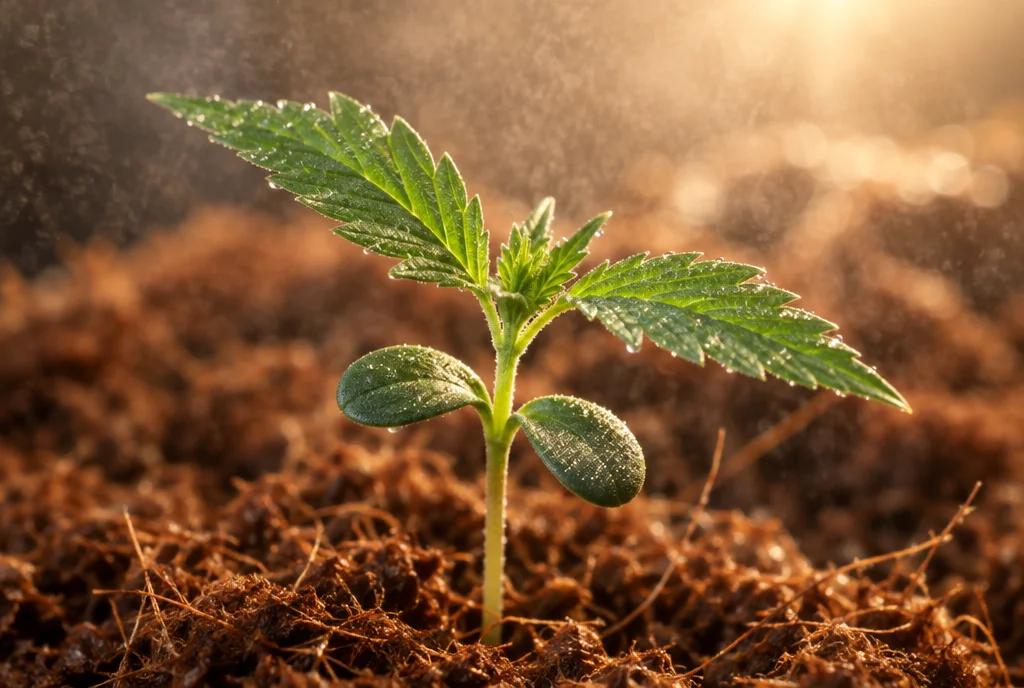
The seed cracked, the sprout popped up, the first little leaves opened. And then, nothing. For a week or two the seedling just sits there, small and a bit droopy, while you wonder whether you’re overwatering, underwatering or need a stronger light. Very often, the missing piece isn’t in the pot at all. It’s in the air.
A Tiny Plant With a Big Leak
A young plant’s roots are only a few centimeters long, so they can’t pull up much water. Its leaves, meanwhile, are constantly losing water to the air through tiny pores called stomata. That process, transpiration, is how a plant moves water and nutrients upward, so a little of it is healthy.
In dry air, though, the leaves lose water faster than the small roots can replace it. The seedling protects itself by closing its stomata, and with its stomata closed, it barely grows. Clones have it even harder: they start out with no roots at all, and depend on humid air to survive while they grow some.
VPD: The Number Behind “Humid Enough”
Relative humidity alone doesn’t tell the whole story, because warm air can hold more water than cool air. 60% humidity at 20°C feels very different to a plant than 60% at 28°C. That’s why growers use VPD (vapor pressure deficit), which combines temperature and humidity into one number that describes how “thirsty” the air is.
- Low VPD (about 0.4 to 0.8 kPa): humid air and gentle water loss. Ideal for seedlings and clones.
- Medium VPD (about 0.8 to 1.2 kPa): a common target for vegetative growth.
- Higher VPD (about 1.2 to 1.6 kPa): drier air for flowering, which also helps protect dense buds from mold.
Growers argue about the exact numbers, but the direction is universal: humid early, drier late.
The Usual Fixes, and Their Problems
Most home growers fight dry air with a humidity dome, a spray bottle or a standalone humidifier next to the tent. Each one helps, and each one has a catch. Domes are easy to forget and can trap too much moisture. A spray bottle helps for an hour. A separate humidifier is one more device to fill, clean and balance against your fans. And in winter, when indoor air is at its driest, none of them may be enough.
Overdoing it is risky too. Wet, stagnant air invites mold and damping-off, a fungal disease that can wipe out seedlings almost overnight. Young plants need humid air that keeps moving.
How We Solved It for Sunday
Instead of adding another gadget, we built humidity into the airflow itself. Sunday moves air with two fans: one pulls fresh air in, and the other pushes it out through a carbon filter. On the intake side sits a humidifying pad, so incoming air picks up moisture on its way in, before it reaches your plant.
That pad helps Sunday hit ideal VPD levels during the seedling and early vegetative stages, exactly when young plants need it most. The fans keep the air moving the whole time, so it stays humid without going stale. As your plant grows toward flowering, Sunday shifts the climate toward the drier conditions buds prefer. Changing conditions from stage to stage like this is part of crop steering, the technique professional growers use to guide how a plant develops.
There’s no separate humidifier to manage. The pad is a simple consumable that you replace at the start of each grow cycle, along with the carbon filter, so every grow starts fresh.
The Takeaway
If your seedlings are stuck, look at the air before you change anything else. Warm, humid, gently moving air gives a young plant the easy start it needs, and everything that comes later builds on that start.
Let Sunday do the growing
Sunday automates light, climate, watering and feeding, the way the pros do it. Join the waitlist to be first in line when pre-orders reopen.