
Sunday vs Hey abby: Which Automated Grow Box Is Right for You?
If you’re shopping for an automated grow box, Hey abby is probably one of the first names you’ve come across. It’s one of the best-known boxes on the market, and for good reason. Sunday is the box we built. Obviously we’re biased, so instead of telling you which one to buy, this guide explains the choices that actually matter, how each box handles them, and who each one suits best.
All Hey abby details below come from Hey abby’s website, retailer listings and published reviews as of October 2026. Product lines change, so check the latest specs before you buy.
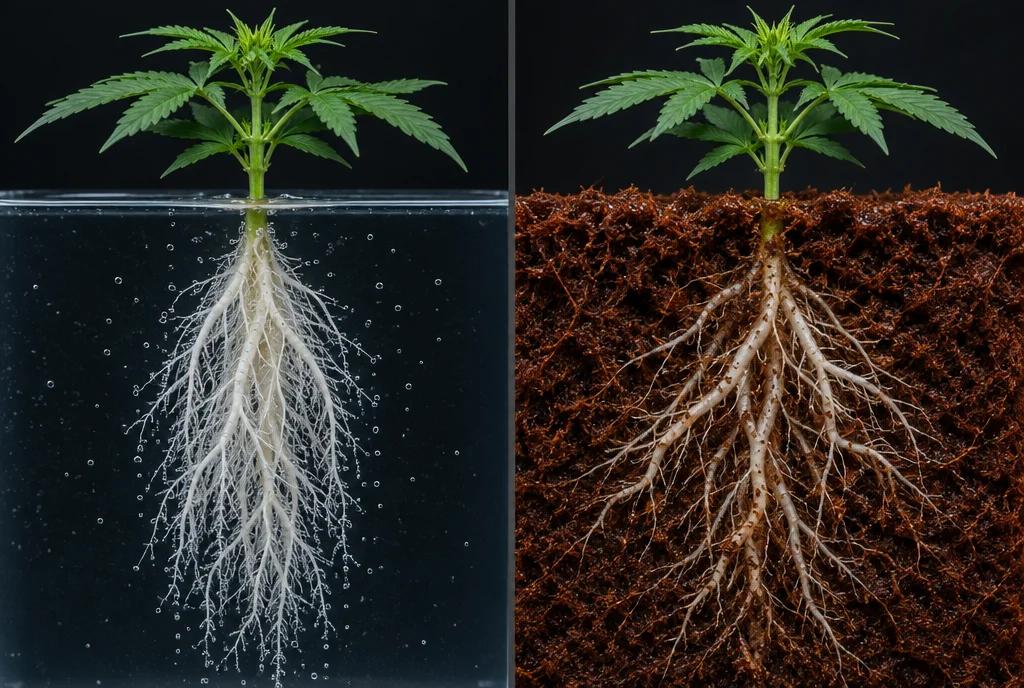
The Biggest Difference: How the Roots Grow
Before comparing features, it helps to understand that these two boxes grow plants in fundamentally different ways.
Hey abby uses deep water culture (DWC). The plant’s roots hang in a tank of nutrient-rich water, around 3 gallons (about 12 liters) in the OG series, with an air pump bubbling oxygen through it. DWC is popular with hydroponic growers because roots have constant access to water, nutrients and oxygen, which can mean fast growth. The trade-offs: the same water circulates around the roots for days at a time, so its pH and nutrient strength drift and need managing, the tank has to be drained and refilled regularly, and warm water holds less oxygen, which raises the risk of root rot.
Sunday uses drain-to-waste in coco coir. The roots grow in coco coir, a clean, soil-free medium that holds both water and air. Each irrigation is freshly mixed, delivered through drip lines, and the excess drains out into a separate runoff container, so used water never goes back to the roots. It’s the method many commercial growers use for its control: because every feed starts fresh, there’s nothing to drift, and measuring the runoff shows how the plant is drinking. We explain why that matters in How Often Should You Water Cannabis?
Neither method is “correct.” DWC is simple and fast when it’s well managed. Coco drain-to-waste is more forgiving and easier to steer.
Feeding: Measured or Scheduled?
Both boxes automate light, airflow and climate monitoring, and both are run from an app. The real difference is in the feeding, and it comes down to one question: does the box actually measure what the roots are sitting in?
Hey abby lists temperature, humidity, water temperature and water level sensors in its published specs, but no pH or EC sensor. Nutrients come as pre-measured fertilizer packs that you add to the DWC tank when the app prompts you, along with reminders to drain the system and to trim. Draining is easy, since the box pumps the water out for you, and Hey abby estimates around 15 minutes of work a week.
The catch is what happens between water changes. As the plant feeds, it takes up water and nutrients at different rates, so the solution in the tank gets stronger or weaker and its pH drifts. Without a pH or EC sensor, the box has no way of seeing that drift. Each new pack goes into a solution nobody has measured. As we explain in pH and EC, Explained, a plant can go hungry in a tank full of food when the pH is off, and the usual instinct, adding more nutrients, only makes it worse.
Sunday does the feeding itself, and measures it. It has two tanks: you pour fresh water into the first, and Sunday mixes each irrigation batch in the second, automatically dosing nutrients and adjusting pH and EC for your plant’s current stage. Every batch is fresh, so there’s no old solution to drift, and Sunday’s pH and EC sensor checks the mix instead of guessing. The sensor is wireless, so calibrating it is easy, and the app walks you through it.
Every day, Sunday also measures how much runoff came out and adjusts the watering to how much the plant actually drinks. Power users can go one step further and use the sensor to measure the runoff’s pH and EC, fine-tuning the mix to what the plant is absorbing to squeeze even more out of every grow.
Your list stays short: refill the water tank roughly once a week, swap the nutrient cartridges, carbon filter and humidifier pad once per grow, calibrate the sensor occasionally, and trim with the app’s help.
Cameras and Humidity: Built In or Add-On
Two features that make a real difference are a camera, so you can check your plant without opening the door, and humidity control, which young plants need (see Why Seedlings Stall in Their First Weeks).
Hey abby offers both as app-connected accessories: a WiFi bud camera and a smart humidifier, sold separately. Reviewers have noted that the box itself could use more humidity control.
Sunday has both built in. Dual HD cameras photograph the plant every 10 minutes for live viewing, AI plant health monitoring and automatic growlapses, and the same cameras measure plant height so the LED can adapt. A humidifying pad on the air intake helps hit the right VPD for seedlings and young plants.
Size and Lighting
Hey abby’s 420 and OG boxes measure about 40 × 40 × 122 cm (15.75 × 15.75 × 48 in), with about 80 cm (31.5 in) of grow height, and use Samsung LEDs. It’s a slim box that fits into tight spaces.
Sunday measures 60 × 60 × 110 cm, giving it more than twice the footprint, built for a wide canopy: the plant is trained flat under a SCROG net so more of it sits in strong light. Its 100W full-spectrum LED reaches a PPFD of 963 μmol/m²/s at 2.7 μmol/J, and dims from 0 to 100% based on growth stage, plant height and distance. We couldn’t find a published wattage or PPFD for Hey abby’s lights.
A Word on Yield Claims
Hey abby advertises up to 8 oz (about 225 g) of dry flower for its OG Pro. It’s worth doing the math on that. The whole box is about 40 × 40 cm, or 0.16 m², and the canopy inside is smaller still. 225 g from that space works out to roughly 1.4 kg per square meter. Well-run commercial grow rooms, with professional lighting, climate control and full-time staff, typically harvest somewhere around 400 to 600 g per square meter. A claim of more than double that, from a small box, should be taken with a big grain of salt.
Our own estimate for Sunday is about 100 to 150 g per grow. Across Sunday’s 0.36 m² footprint, that’s roughly 280 to 420 g per square meter: ambitious for a home grow, but in line with what a wide canopy, strong light and precise feeding can realistically deliver. Real yields always depend on strain and how you train the plant.
Smell, Noise and Safety
Both boxes use activated carbon filtration to control smell. Sunday adds a Quiet Mode that slows the fans at night for bedrooms, and an app-controlled child safety lock built into its wooden cabinet, which matters if you share your home with kids. We wrote more about that in How Much Work Is a Home Grow?
Strains, Price and Availability
This is where Hey abby has clear advantages today.
- Autoflowers. Hey abby supports both photoperiod and autoflowering strains. Sunday is currently optimized for photoperiod strains, with autoflower support in the works.
- Price. Hey abby’s range starts well under $1,000, with the 420 editions listed from about $500 and the OG Pro at about $1,100 at the time of writing. Sunday’s retail price is $1,800, with early backers getting it for $999 to $1,399.
- Availability. Hey abby is in stock and ships to many countries. Sunday hasn’t started shipping yet. Deliveries will start in the US and expand globally from there, and the waitlist gets first access.
So Which One Should You Choose?
Choose Hey abby if you want to start growing right away, you’re on a tighter budget, you want to grow autoflowers, you like hydroponics, or you have limited floor space and don’t mind managing the reservoir.
Choose Sunday if you want feeding, pH and watering fully handled for you and actually measured by sensors, you want the control of the drain-to-waste method professionals use, you want cameras and humidity control built in rather than added on, or you need a box that locks and looks like furniture in a shared home.
Either way, you’ll be growing at home, and that’s a great place to start.
Let Sunday do the growing
Sunday automates light, climate, watering and feeding, the way the pros do it. Join the waitlist to be first in line when pre-orders reopen.