
Sunday vs VIVOSUN VGrow: Which Smart Grow Box Fits Your Home?
If you’re shopping for a smart grow box, the VIVOSUN VGrow is likely on your list. VIVOSUN is one of the best-known names in home grow equipment, and the VGrow packs light, fans, a carbon filter and an app into a compact, affordable box. Sunday is the box we built. We’re obviously biased, so instead of telling you which to buy, this guide explains the choices that actually matter, how each box handles them, and who each one suits.
All VGrow details below come from VIVOSUN’s own product page and user manual for the VGrow Y18 (model VG-Y18B), plus a retailer listing, as checked in October 2026. Products change, so check the latest specs before you buy.
The Biggest Difference: How Water and Food Reach the Roots
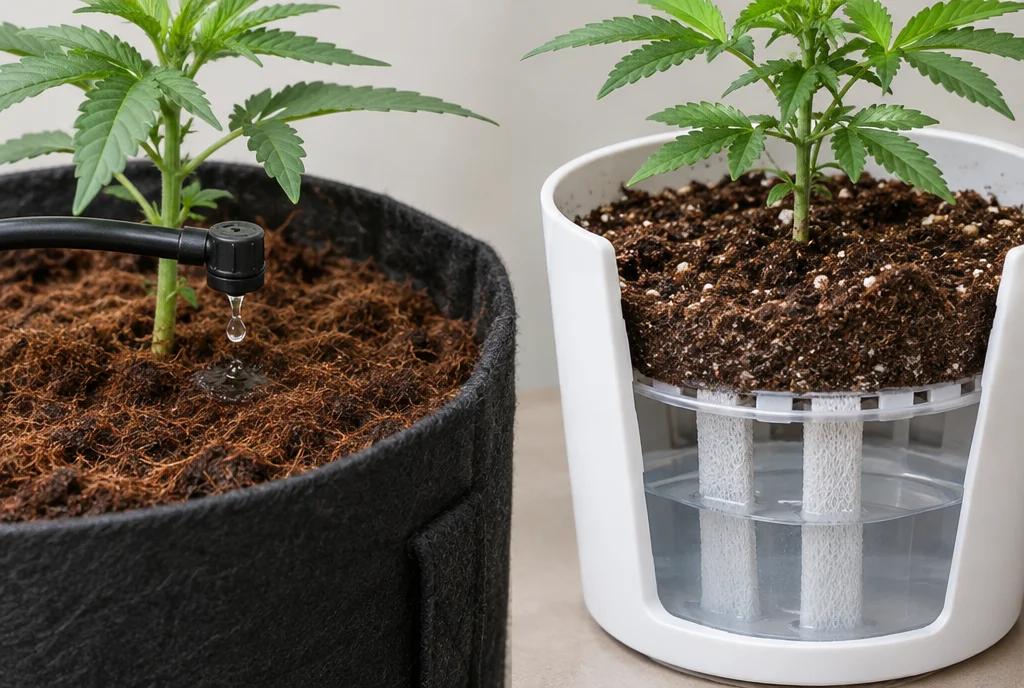
Both boxes can grow in coco coir, but they water it in very different ways.
VGrow uses a self-watering pot. The kit includes coco coir and a grow bag, and the plant sits in a self-watering pot with a 6-liter (1.6-gallon) reservoir. In a self-watering pot, the medium draws water up from the reservoir as the plant needs it. A water level sensor tells you when to refill, and one retailer describes the routine as simple weekly refills. VIVOSUN says the system is upgradable to drip irrigation or deep water culture (DWC).
Sunday uses drain-to-waste drip irrigation. Each irrigation is freshly mixed and delivered through drip lines, and the excess drains into a separate runoff container, so used water never goes back to the roots. Every day, Sunday measures how much runoff came out and adjusts the watering to how much the plant actually drank. It’s the method many commercial growers use, because every feed starts fresh and the runoff tells you how the plant is drinking. We explain why that matters in How Often Should You Water Cannabis?
Neither approach is wrong. Self-watering is simple and forgiving of a missed day. Drain-to-waste takes more equipment, but gives more control.
Feeding: Who Mixes the Nutrients?
VGrow comes with a starter supply of Part A and Part B nutrients, a syringe and a small measuring pitcher. You mix and add the nutrients to the self-watering pot yourself, and the box’s status light flashes when it’s time to add water or nutrients. The sensors VIVOSUN lists are temperature, humidity (inside and outside the box) and water level. We didn’t find a pH or EC sensor in its specs, so checking the pH and strength of the solution is up to you, if you choose to. Why that can matter is covered in pH and EC, Explained.
Sunday does the mixing itself. You pour fresh water into the first of its two tanks. Sunday mixes each irrigation batch in the second, dosing its own Part A and Part B nutrients plus pH Up and pH Down, and adjusting pH and EC for the plant’s current stage. A wireless pH & EC sensor checks the mix, and the app walks you through calibrating it. Irrigation follows the Athena crop steering protocol, adapted to Sunday’s runoff detection. We explain that in The Athena Protocol, Explained for Beginners.
Light and Climate
Both boxes use a 100W full-spectrum LED. VGrow’s uses Samsung LM301H EVO diodes with a spectrum that changes by stage: more blue for seedlings and added red and far-red for flowering. It also dims automatically if the temperature inside reaches 33°C (92°F). We couldn’t find a published PPFD figure for the VGrow’s light.
Sunday’s LED delivers a PPFD of 963 μmol/m²/s at 2.7 μmol/J with a blue-enhanced full spectrum. It dims from 0 to 100%, adapts its intensity to the growth stage and to the plant’s height, measured by the cameras, and dims gradually once the plant has had enough light for the day.
For climate, VGrow has a 35 CFM ventilation fan with a compact activated carbon filter (VIVOSUN recommends replacing it every three months) and a multi-layer air circulation system, with temperature and humidity sensors. A humidifier is available as an add-on. Sunday has an intake fan and an extraction fan, a carbon filter on the exhaust, a humidifier pad on the intake to help seedlings and young plants (see Why Seedlings Stall), and a Quiet Mode that slows the fans at night. Sunday manages temperature by exchanging air with the room, and the VGrow’s specs list ventilation rather than any active cooling, so with either box, where you put it matters.
Cameras
The VGrow has USB ports for VIVOSUN accessories, including a camera, sold separately. Sunday has dual HD cameras built in. They take a photo every 10 minutes for live viewing, AI plant health monitoring and automatic growlapses, and they also measure the plant’s height for the light.
Size and Build
The VGrow measures 46 × 46 × 122 cm (18 × 18 × 48 in), with about 92 cm (36 in) of grow height for one plant, and weighs 11.8 kg (26 lb). It’s built from a frame with a zip-on, double-sided faux leather skin, a viewing window and a magnetic seal. It’s light, slim and easy to move.
Sunday measures 60 × 60 × 110 cm, a wooden cabinet with an app-controlled child safety lock. Its footprint is about 0.36 m², compared with about 0.21 m² for the VGrow. That extra width is for a wide canopy: the plant is trained flat under a SCROG net, which comes in the first grow kit. We explain the technique in SCROG Explained.
A Word on Yield Figures
VIVOSUN lists the VGrow’s yield as “up to 227 g / 8 oz.” Our own estimate for Sunday is about 100 to 150 g per grow. Both are estimates, and “up to” figures describe the best case. Real harvests depend on the strain, the grower and how the plant is trained, so it’s worth comparing any box’s yield claim against its floor space and asking what a typical first grow produces.
Where VGrow Has Clear Advantages
- Price. VIVOSUN’s own store listed the VGrow at $499.99 (down from $599) when we checked, and one retailer listed it at $599. Sunday’s retail price is $1,800, with early backers having paid $999 to $1,399.
- Availability. The VGrow is in stock and shipping now. Sunday hasn’t started shipping yet. Deliveries will begin in the US and expand globally, and the waitlist gets first access to the next batch.
- Flexibility. You can set the stage and customize the light schedule yourself, and upgrade to drip or DWC. Sunday is currently optimized for photoperiod strains, with autoflower support in the works.
- Size and weight. A smaller footprint and a 26 lb build make the VGrow easy to fit and move.
- Drying, too. Like Sunday, which has a post-harvest drying mode, the VGrow includes a drying stage in its controls.
Where Sunday Has Clear Advantages
- Automated feeding and pH. Sunday mixes and doses nutrients and adjusts pH and EC on its own, with a sensor checking the mix.
- Drain-to-waste with runoff measurement. Every feed is fresh, and watering adapts daily to what the plant actually drinks.
- Cameras and humidity built in. Dual HD cameras with AI health monitoring and a humidifier pad come standard.
- Security and design. A wooden cabinet with an app-controlled lock, for homes with kids or visitors.
- Room for a wide canopy. About 70% more floor area, plus a published, high-output light.
So Which One Should You Choose?
Choose the VGrow if you want to start growing now, you’re on a budget, you like being hands-on with feeding, you want to experiment with different strains, schedules or hydro upgrades, or you need something light and compact.
Choose Sunday if you want feeding, pH and watering handled for you and measured by sensors, you want the drain-to-waste control professionals use, you want cameras and humidity control built in, or you need a box that locks and looks like furniture in a shared home.
Either way, you’ll be growing your own, and that’s a great place to start. If you’re still weighing your options, we also compared Sunday with another popular box in Sunday vs Hey abby.
Let Sunday do the growing
Sunday automates light, climate, watering and feeding, the way the pros do it. Join the waitlist to be first in line when pre-orders reopen.