
Is Growing Cannabis at Home Actually Cheaper? Here’s the Real Math
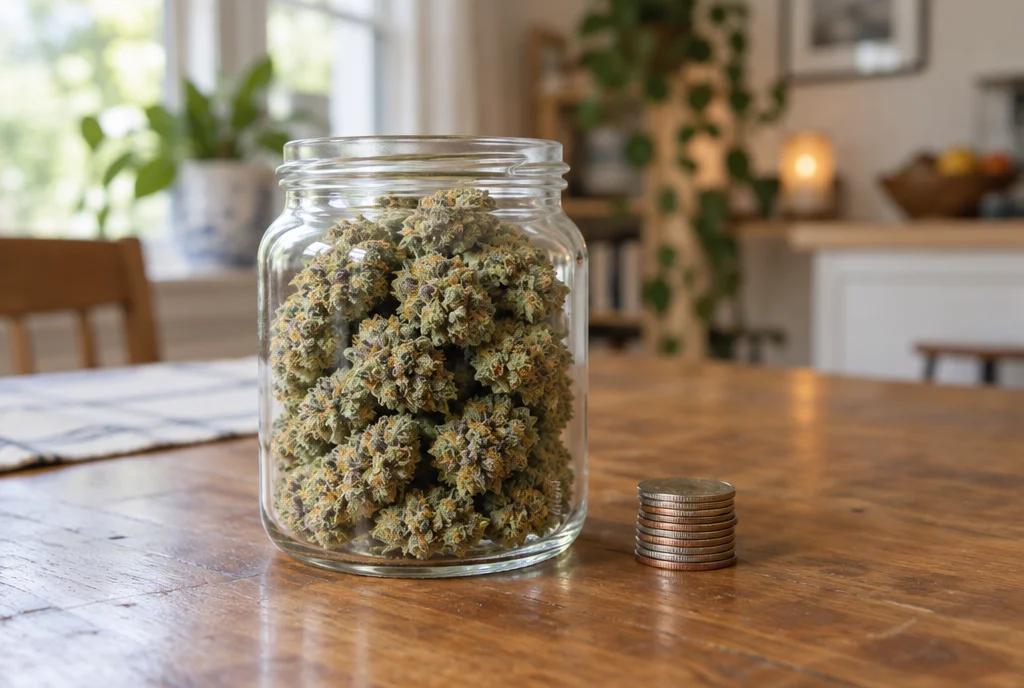
Every grower has heard it: “Growing your own is way cheaper than buying.” It’s usually true, but rarely explained. Gear costs money, electricity costs money, and a failed grow costs the most of all. So let’s do the math properly: what a home grow really costs, what it produces, and when it starts paying you back.
What You’re Comparing Against
Start with what you pay now. Legal dispensary prices vary a lot by state and quality, but top-shelf flower commonly sells for around $10 to $15 a gram, and often more in heavily taxed markets. An eighth (3.5 g) at $40 to $50 is about the same thing.
That’s the number to beat. Every gram you grow instead of buying saves you that price, minus what it cost you to grow it.
The Three Costs of a Home Grow
- Equipment. This is the big one, and you pay it once. A DIY setup means a tent, a quality LED, fans, a carbon filter, pots, and pH and EC meters. Buying decent parts separately, it’s easy to spend several hundred to over a thousand dollars before your first seed goes in.
- Running costs. Electricity, nutrients, growing medium, seeds and filters. These come back every grow.
- Risk. The cost nobody puts in the spreadsheet. A first grow lost to mold, root rot or a pH problem doesn’t just waste the supplies. It wastes two to three months.
Electricity: Smaller Than You Think
Electricity is the running cost people worry about most, so let’s put a number on it. A grow light is measured in watts, and your power bill in kilowatt-hours (kWh), which is 1,000 watts running for one hour.
Take a 100W LED, the maximum power of Sunday’s light, on a typical schedule: about four weeks of vegetative growth at 18 hours a day, then about eight weeks of flowering at 12 hours a day. Even if the light ran at full power the entire time, that’s under 120 kWh for the whole grow. At the average US residential rate of roughly 17 cents per kWh, that’s about $20.
Fans, pumps and electronics add a little more, but electricity for a small, efficient grow stays in the tens of dollars per grow, not hundreds. The light is what matters, and efficiency is everything: an older, less efficient lamp can use several times the power to deliver the same light.
The Other Side: How Much You Harvest
Costs only mean something next to the harvest. Yield depends on strain, light, training and, above all, how well the grow goes. A small, well-run indoor grow commonly produces 100 to 150 grams of dried flower. A struggling one can produce a fraction of that, which is why risk belongs in the math.
At $10 to $15 a gram, 100 to 150 grams is roughly $1,000 to $2,250 worth of flower from a single grow.
When Does It Pay for Itself?
Here’s the simple formula:
- Value of a grow = grams harvested × what you’d pay per gram.
- Profit per grow = value of a grow − running costs.
- Payback = equipment cost ÷ profit per grow.
With running costs in the low hundreds or less and a harvest worth $1,000 or more, even a $1,000 to $2,000 setup typically pays for itself within one or two successful grows. Most cannabis strains take 8 to 14 weeks from seed to harvest, so that’s a matter of months, not years.
One honest caveat: savings only count for cannabis you would actually have bought. If a grow produces more than you use in a few months, the real saving is what you no longer spend, not the full dispensary value of the jar.
How We Designed Sunday Around the Numbers
When we built Sunday, we looked hard at each of those three costs.
Equipment: Sunday replaces the whole DIY shopping list with one box: a 100W full-spectrum LED, fans, a carbon filter, automatic irrigation and dosing, a wireless pH and EC sensor, dual cameras and an app-controlled lock, all in wooden furniture. Its retail price is $1,800.
Running costs: the LED is efficient, at 2.7 μmol/J, and it gradually dims once your plant has had enough light for the day, so you don’t pay for light the plant can’t use. Per grow, you replace the nutrient cartridges, carbon filter and humidifier pad, and grow in coco coir. We designed Sunday so you can grow top-quality cannabis for less than $1 per gram.
Risk: this is where automation pays off most. Sunday doses nutrients, adjusts pH and EC, measures the runoff and adjusts the watering every day, using crop steering techniques developed with expert growers. Its cameras watch the plant every 10 minutes and alert you if something looks wrong. Fewer failed grows means the math actually works out the way it does on paper.
Each grow with Sunday yields about 100 to 150 grams. At typical US prices, that’s roughly $1,000 to $2,250 worth of flower per grow, so even at full retail price, Sunday pays for itself within one to two grows.
Value You Can’t Put in a Spreadsheet
Money isn’t the only return. When you grow your own, you know exactly what went into it, including no pesticides (we wrote about why that matters in The Scary Truth About Pesticides in Cannabis). You choose the strain, you control the quality, and there’s something satisfying about a jar of flower you watched grow from a seed.
The Takeaway
Growing at home is cheaper, as long as the grow succeeds. Electricity is a small cost, equipment is a one-time cost, and a failed grow is the expensive one. Price your setup, estimate a realistic harvest, and run the payback formula with your own local prices. For most people who buy regularly, the numbers make a strong case.
Let Sunday do the growing
Sunday automates light, climate, watering and feeding, the way the pros do it. Join the waitlist to be first in line when pre-orders reopen.