
SCROG Explained: Training Your Plant for Bigger Yields
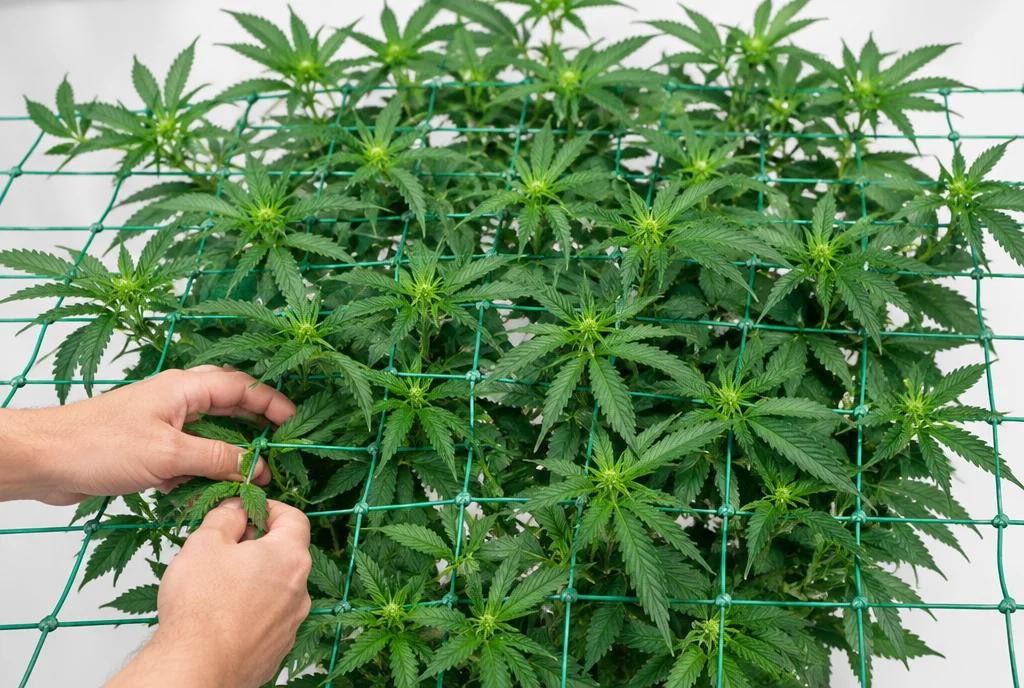
Left alone, a cannabis plant grows like a Christmas tree: one big top bud close to the light, and a lot of small, airy buds hidden underneath. SCROG, short for “screen of green,” is a simple training method that turns that tree into a flat table of evenly lit buds, and it’s one of the most effective ways to get more out of a small grow space.
Here’s why it works, how to do it, and the mistakes that trip up most first attempts.
Why Plants Grow Tall Instead of Wide
Cannabis, like many plants, shows apical dominance: the main growing tip at the top of the stem grows fastest, and it sends out hormones (mainly one called auxin) that hold back the side branches below it. Outdoors, that makes sense. A tall plant beats its neighbors to the sun.
Indoors, it works against you. A grow light is strongest right under it and gets weaker the further away you go. So the top of the plant gets bathed in light, while the lower branches sit in shade.
Researchers have measured how big that difference is. In a study of large medicinal cannabis plants, light at the top of the canopy was about 1,200 μmol/m²/s, while at the base it dropped to roughly 100 to 300. Cannabinoid concentrations in the lowest flowers were up to 40% lower than higher up. A follow-up study from the same group found that flowers from the bottom of the plant could have up to 90% less cannabinoids than the main top bud. In other words, the buds you grow in the shade are not just smaller. They’re weaker.
(If you want the full story on light, see How Much Light Does Cannabis Really Need?)
What SCROG Does
The idea is simple. You stretch a horizontal net, usually with square holes a few inches wide, above the pot. As the plant grows up through it, you bend and tuck each growing tip back under the net and out to the side. Instead of one tall top, you end up with many branch tips spread evenly across the net, all at the same height and the same distance from the light.
That gives you three wins:
- More of the plant in strong light. Every branch tip gets close to the lamp, so many tips develop into solid buds instead of one big cola and a lot of larf (small, airy buds).
- Better use of a small space. In a box or tent, floor area is the limit. A wide, flat canopy fills it.
- Better airflow. Spreading the plant out opens up the middle, which helps keep humidity down around the buds late in flower.
SCROG itself hasn’t been tested much in controlled trials, but the principle behind it has. In the first of those studies, removing the lowest, shaded branches and some leaves let more light reach the rest of the plant, made the flowers more uniform, and didn’t significantly reduce yield. That’s exactly what a good SCROG does.
How to SCROG, Step by Step
- Top the plant early. Once the young plant has several sets of leaves, many growers cut off the main tip (“topping”). This breaks apical dominance and splits growth into two main shoots, giving you more branches to work with.
- Install the net. Fix it level, a little above the top of the plant, with enough space below for you to get your hands in.
- Tuck, don’t cut. As branch tips grow a few inches above the net, gently bend them back under and move them to an empty square. Work with the plant every day or two. Bend near the softer, younger part of the stem so it doesn’t snap.
- Fill the net, then flower. When most of the net is covered, it’s time to switch to the flowering light schedule (12 hours on, 12 off for photoperiod plants). Plants keep growing a lot in the first weeks of flower, which growers call “the stretch,” so leave room for it.
- Keep tucking through the stretch. Continue guiding tips under the net for the first couple of weeks of flower. After that, let the tips grow straight up through the net. Those become your buds.
- Clean up underneath. Remove small shoots and leaves below the net that will never see much light. Growers call this “lollipopping.” The plant puts that energy into the buds on top instead.
Common SCROG Mistakes
- Flipping too late. If the net is already packed before flowering, the stretch will turn it into a jungle. Switch a little early.
- Tucking too late. Once buds are forming, stems get stiff and tucking can damage them. Do most of the training before and during the stretch.
- Snapping branches. Bend slowly, and if one cracks, support it. Cannabis often recovers from a minor kink, but a clean break is lost.
- Leaving everything underneath. The bottom growth competes with the canopy for water and nutrients and blocks airflow.
- Training an autoflower like a photoperiod plant. Autoflowers flower on their own schedule, so there’s less time for training and recovery. We cover the difference in Photoperiod vs Autoflower.
How We Solved It for Sunday
We designed Sunday around a SCROG grow. Its 60 × 60 cm footprint is built for a wide canopy, and a SCROG net comes in your first grow kit, along with pruning scissors.
The tricky part of SCROG for most beginners is timing: when to tuck, when to trim, when to stop. Sunday’s app notifies you when it’s time to act, with guided instructions, and most of that work happens in the second half of the grow. It’s optional, but training under the net increases yield. Sunday’s dual HD cameras photograph your plant every 10 minutes, so you can watch the canopy fill in from your phone and see how each change works out.
The light is designed for a flat canopy too. Sunday’s 100W full-spectrum LED delivers a PPFD of 963 μmol/m²/s, and it adjusts its intensity to the plant’s growth stage and to the plant’s height, which the cameras measure, and its distance from the light. As your SCROG canopy rises toward the lamp, the light adapts.
That combination is a big part of why we estimate a Sunday grow at about 100 to 150 grams of dried flower, depending on the strain and how you train the plant. And if you’re curious about the other professional techniques that shape a Sunday grow, read The Athena Protocol, Explained for Beginners.
The Takeaway
Indoor plants waste a lot of potential on shaded lower buds. SCROG fixes that by spreading the plant flat under a net so every branch tip gets strong light. Top early, tuck often, flip before the net is full, keep tucking through the stretch, and clear out what’s underneath. It takes a few minutes every couple of days, and it’s one of the most rewarding skills a home grower can learn.
Let Sunday do the growing
Sunday automates light, climate, watering and feeding, the way the pros do it. Join the waitlist to be first in line when pre-orders reopen.