
When to Harvest: How to Read Trichomes
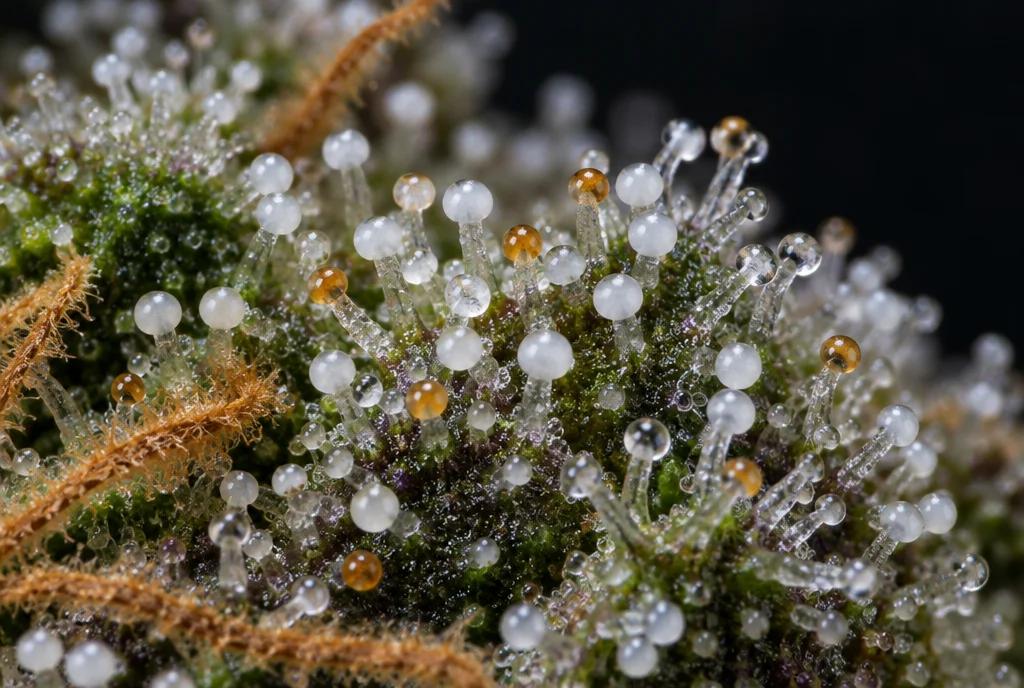
After months of care, the most common question in home growing comes down to a single day: when do I cut it down? Harvest too early and you lose potency and weight. Wait too long and the buds start to fade. The most reliable answer isn’t on the calendar or in the color of the hairs. It’s in the trichomes, and you only need a cheap magnifier to read them.
What Trichomes Are
Look closely at a flowering bud and you’ll see it’s covered in tiny, sparkling crystals. Those are trichomes: microscopic resin glands shaped a bit like mushrooms, with a stalk and a round head. The head is where the plant makes and stores most of its cannabinoids, like THC and CBD, along with the terpenes that create its aroma.
Not all trichomes are equal. A 2020 study from the University of British Columbia found that the large stalked trichomes on mature flowers produce more cannabinoids than the smaller ones without stalks, thanks to their bigger heads. Those big, mushroom-shaped glands on the buds are the ones you want to watch.
How a Bud Ripens
Cannabinoid levels don’t rise forever. A University of Florida study that tested hemp flowers every week found that THC, CBD and CBG rose as the flowers matured, peaked around six to seven weeks after flowering began, held at a plateau whose length varied by variety, and then declined as the plants aged. Drug-type cannabis varieties follow their own timelines, but the shape is the same: a climb, a plateau, a decline. Your goal is to harvest during the plateau.
The plant doesn’t announce that plateau, but its trichomes change appearance as it goes:
- Clear. Early in flower, the heads look like tiny glass beads. The bud is still developing.
- Cloudy or milky. As the flower matures, the heads turn opaque white. Most growers treat this as the sign that the bud is at or near its peak.
- Amber. Later, more heads turn golden or brown. This is a sign of aging. THC slowly breaks down into a compound called CBN when it’s exposed to oxygen, light and heat, and amber heads are widely taken as a signal that this degradation has started.
Clear, Cloudy, Amber: Choosing Your Moment
There’s no single perfect ratio, but most growers use roughly these targets:
- Mostly cloudy, a few clear: an early harvest. Some growers prefer it for a brighter, more energetic effect.
- Mostly cloudy, a few amber: the classic harvest window, and a good default if you’re unsure.
- Lots of amber: a late harvest. Many growers say it feels heavier and more relaxing.
A word of caution about that last point: you’ll often read that amber trichomes mean “sleepy” weed because of CBN. The science behind that is thin. A 2021 systematic review in Cannabis and Cannabinoid Research found no clinical trials testing CBN against validated sleep measures, and most of the available human evidence suggests CBN on its own has little cannabis-like effect. Effects depend far more on the strain, the dose and the person. So treat the cloudy-to-amber ratio as a way to pick ripeness, not as a dial for a specific feeling.
How to Check Your Trichomes
- Get magnification. A jeweler’s loupe of around 60x or a small pocket or USB microscope is enough. Phone cameras usually can’t get close enough on their own.
- Look at the buds, not the leaves. The small “sugar leaves” around the buds often turn amber earlier than the flowers themselves. Focus on the trichomes on the calyxes, the little teardrop-shaped pods that make up the bud.
- Sample several spots. Check a top bud and a few lower ones. Buds closer to the light often ripen faster.
- Check every day or two near the end. Things can move quickly in the final week or two.
- Use the breeder’s flowering time as a guide, not a rule. If the seed packet says eight to nine weeks of flowering, start checking around week seven.
Signs That Can Mislead You
The hairs. The white hairs on a bud, called pistils, turn orange or brown as flowers mature, and many beginners harvest when most have darkened. But pistils also change color from stress, heat or simply being touched. They’re a rough hint, not a decision tool.
Fading leaves. Leaves often yellow in late flower as the plant moves nutrients into the buds. That can be normal, but it can also be a feeding problem. We explain how to tell the difference in What Your Cannabis Plant Is Telling You.
The calendar. Even a well-described strain can finish a week earlier or later depending on light, temperature and how the plant was grown.
How We Solved It for Sunday
Harvest timing is about watching closely, every day, at the end of a long grow, which is exactly when many home growers lose patience.
Sunday helps you keep watch. Its dual HD cameras photograph your plant every 10 minutes, so you can see how the buds are developing from anywhere through the live view in the app, and AI plant health monitoring keeps an eye on the plant for you. Most strains take about 8 to 14 weeks from seed to harvest in Sunday, and the app notifies you with guided instructions whenever something needs your attention.
For the final call, a close-up look with a loupe is still the most reliable check, and that’s part of the fun. If you’re unsure what you’re seeing, Sunday’s agronomists are available in the app to help. And once you’ve made the cut, Sunday’s post-harvest drying mode gives your buds a controlled start to drying. We cover the rest of that process in How to Dry and Cure Cannabis.
The Takeaway
Pistils and calendars give you a rough idea. Trichomes give you the answer. Get a 60x loupe, check the buds themselves rather than the leaves, and harvest when most of the heads have turned milky, with a few amber if you like. Your plant spent months building that resin. A few days of close attention at the end makes sure you get the best of it.
Let Sunday do the growing
Sunday automates light, climate, watering and feeding, the way the pros do it. Join the waitlist to be first in line when pre-orders reopen.